

You Were Valuable Before You Were Useful
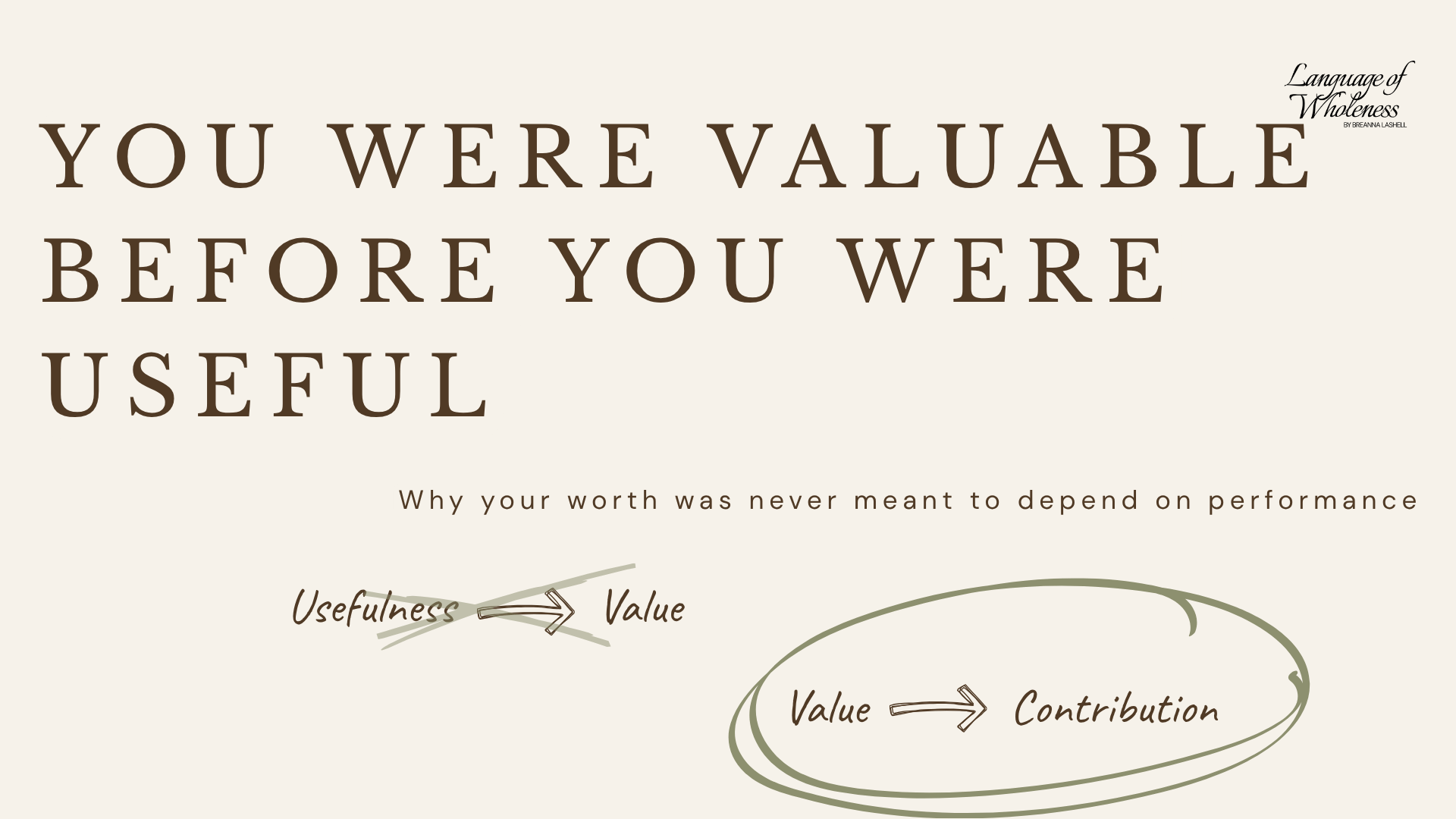
After more than a decade of working with leaders, founders, and organizations, I have noticed a question hiding underneath a surprising amount of ambition:
“If I do this, will I finally be valuable?”
Maybe no one says it that plainly.
Instead, it sounds like:
If I build the company...
If I reach six figures...
If I become indispensable...
If I help enough people...
If I become a good enough parent...
If I earn the degree...
If I get the promotion...
If people respect me...
Then I will know that I matter.
It is an incredibly human question.
It is also one I have wrestled with throughout different seasons of my own life and career.
But underneath the question is an assumption worth challenging:
That value is something we earn.
And when we build our lives around that assumption, it changes the way we work, lead, love, parent, achieve, fail, and even rest.
Because if you believe you begin from a deficit—if somewhere inside you believe you must become valuable—you inevitably start asking accomplishments, relationships, and roles to prove something they were never designed to prove.
We ask our lives to prove our worth.
Imagine someone who believes being a good parent is what makes them valuable.
Parenthood can slowly become more than a relationship or responsibility. Their children's choices, accomplishments, affection, or behavior can begin functioning as evidence of whether they are a good and worthwhile person.
Or imagine a founder who believes reaching six figures will finally make them feel successful enough to matter.
Suddenly, that revenue goal isn't simply a business goal anymore.
It is carrying the weight of their identity.
So they push harder.
They exceed their capacity.
They ask their team to do the same.
They sacrifice rest, relationships, boundaries, and sometimes their health because the number has become about much more than money.
And then something strange happens.
They reach it.
And they still don't feel like enough.
Because no achievement can permanently answer a question about human worth.
When we attach our value to people, possessions, roles, accomplishments, or outcomes, we create unhealthy relationships with things we cannot completely control.
And even when we get exactly what we wanted, the feeling rarely lasts.
There is always another number. Another goal. Another milestone. Another person to impress. Another opportunity to prove ourselves.
If value must continually be earned, then there is never really a finish line.
I know what this looks like firsthand.
I started leading a nonprofit organization when I was very young.
I cared deeply about the work, the mission, and the people we served.
But somewhere along the way, something subtle started happening.
The organization's performance became intertwined with the way I saw myself.
When we received good feedback, I felt important.
When something went well, I felt competent.
When an event struggled, or we missed something, I didn't simply think:
That didn't work.
Some part of me heard:
You failed.
And those are two very different statements. One evaluates an outcome. The other evaluates a person. Over time, that distinction became harder for me to see.
The work mattered so much to me that it became easy to believe doing the work well was evidence that I mattered too.
And I have watched versions of this happen with countless other leaders.
When we care deeply about something—and especially when we also crave acceptance, belonging, respect, or validation—we can begin tying ourselves to what we produce.
We quietly start believing:
If I do this well enough...
for long enough...
for enough people...
Then surely everyone—including me—will finally have enough evidence that I am worth something.
But that system never really gives us what we are looking for.
Instead, it often produces exhaustion, perfectionism, resentment, fear, overwork, and an inability to separate failure from identity.
What if value was never something you had to earn?
This is where the Language of Wholeness introduces a different starting point:
Inherent Value.
Inherent Value is the belief that a person's fundamental worth exists before their usefulness, productivity, achievement, status, performance, or contribution.
Your value does not begin when you accomplish something impressive.
It does not increase when people applaud you.
It does not disappear when you fail.
It does not depend upon how productive you were today.
You were valuable before anyone needed something from you.
Before you earned the degree.
Before you built the organization.
Before you became the parent, leader, founder, spouse, executive, helper, or person everyone could depend on.
You were valuable before you were useful.
That doesn't mean our choices don't matter. It doesn't mean performance doesn't matter. It doesn't remove responsibility, accountability, consequences, growth, or standards.
Someone can possess inherent value and still cause harm. Someone can possess inherent value and need to apologize. Someone can possess inherent value and lose trust, responsibility, authority, or access because of their choices.
Value is not the same thing as approval. It is not the same thing as competence. It is not the same thing as character. And it is not permission to avoid accountability.
It simply means that none of those things determine whether someone possesses basic human worth. That distinction changes more than we might realize.
Inherent Value changes the way we lead.
Think about what happens when your work no longer has to prove that you deserve to matter.
You can still pursue excellence.
You can still have enormous goals.
You can still build remarkable things.
But the goal no longer has to carry the weight of your identity.
Failure becomes information rather than a verdict.
Feedback becomes something you can consider rather than something you must defend yourself against.
Rest no longer threatens your sense of usefulness.
Someone else's success does not automatically diminish your own value.
And perhaps most importantly, we begin treating other people differently too.
Because when we believe value must be earned, we don't only apply that standard to ourselves.
Eventually, we apply it to everyone.
We begin deciding who deserves patience based on performance. Who deserves dignity based on behavior. Who is important based on productivity. Who is worth listening to based on status. Who gets compassion based on whether they have sufficiently earned it.
But if value is inherent, then our starting point changes.
A team member can make a mistake without becoming a mistake. A child can disappoint us without becoming a disappointment. A leader can fail without becoming worthless. And we can hold people accountable without first stripping them of their humanity.
That creates a very different kind of family. A different kind of workplace. A different kind of organization. A different kind of leadership.
So how do you know what you believe about your own value?
Sometimes our beliefs are easiest to see through our reactions.
Consider these questions:
When you think about what makes you important, what immediately comes to mind?
Do you think about who you are?
Or do you immediately begin listing what you have accomplished, who needs you, what you own, what you provide, or what others think about you?
2. What happens internally when you experience a setback?
Can you say, “That didn't go the way I hoped”?
Or does it quickly become, “There is something wrong with me”?
3. What happens when someone else fails?
Can you separate their behavior, performance, or decision from their fundamental value as a person?
4. What standards are you currently trying to meet in order to feel worthy?
Whose approval are you still trying to earn?
What accomplishment do you secretly believe will finally make you feel like enough?
5. What would change if you genuinely believed your value was already settled?
Would you work differently?
Rest differently?
Lead differently?
Parent differently?
Handle failure differently?
Set different boundaries?
Treat people differently?
You don't need to manufacture the perfect answer.
Just notice what comes up. The point isn't to shame yourself for tying your worth to achievement. Most of us have been taught to do exactly that in one form or another.
The invitation is simply to begin separating things that were never meant to be synonymous.
Your contribution matters.
Your work matters.
Your choices matter.
Your character matters.
Your growth matters.
But none of those things manufacture your value.
The order matters.
We often live as though the equation works like this:
Contribution → Value
If I contribute enough, eventually I become valuable. But I believe we have the order backward.
The healthier starting point is:
Value → Contribution
You do not contribute in order to become a person who matters. You contribute from the foundation of already knowing that you do. And those two ways of living can produce dramatically different lives.
One is constantly asking:
“Have I done enough to deserve my place here?”
The other can ask:
“Because my value is already secure, how do I want to steward what I have been given?”
That is a very different relationship with ambition. A very different relationship with leadership. And a very different relationship with yourself.
So if nothing else, I hope you leave this conversation remembering one thing:
Your contributions matter because you possess value.
You do not possess value because of what you contribute.
The order matters. And so do you.
